

Email marketing is essential for both B2B and B2C businesses. Each approach has unique strategies and goals.
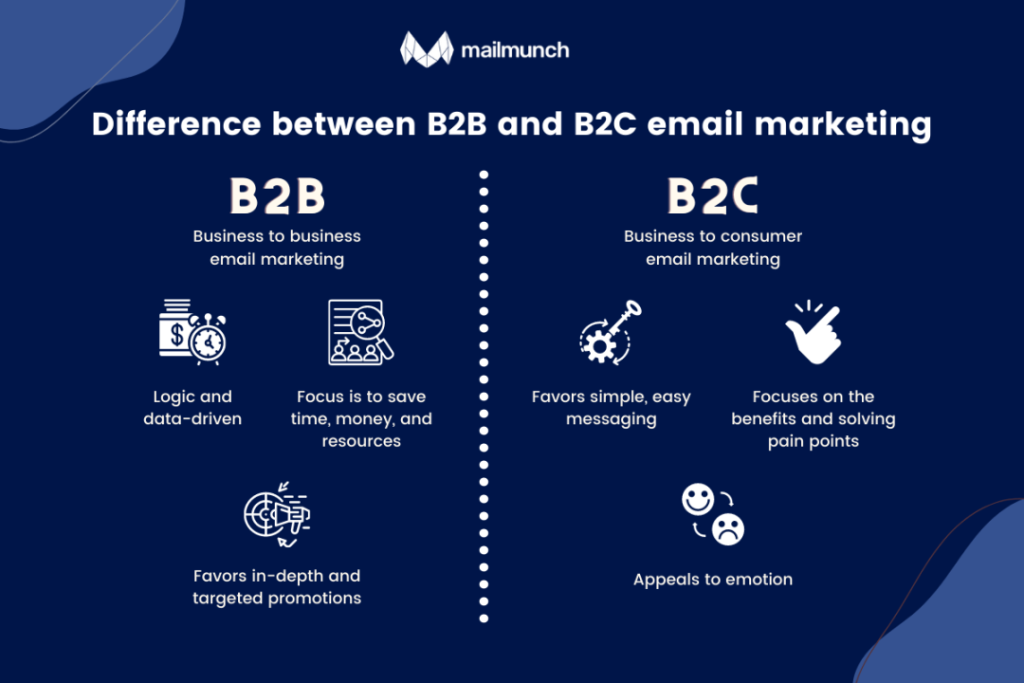
Understanding the differences between B2B and B2C email marketing can help you create effective campaigns. B2B email marketing focuses on building relationships and providing valuable content to professionals. It’s about nurturing leads and driving long-term business growth. On the other hand, B2C email marketing aims to engage individual consumers.
It’s more about creating emotional connections and encouraging quick purchases. Recognizing these differences is key to crafting messages that resonate with your audience. We’ll explore the nuances of B2B versus B2C email marketing. Let’s dive into the strategies that can help you succeed in both realms.
Introduction To Email Marketing
Email marketing is a powerful tool. It helps businesses reach their audience directly. This method allows companies to send personalized messages. These messages can inform, persuade, and build relationships with customers.
There are two main types of email marketing: B2B and B2C. B2B stands for Business to Business. B2C stands for Business to Consumer. Both have unique strategies and goals.
Importance Of Email Marketing
Email marketing offers many benefits. It is cost-effective and easy to implement. Businesses can reach a large audience quickly.
This type of marketing has a high return on investment (ROI). For every dollar spent, the average ROI is $38. Additionally, it helps in building strong customer relationships. Regular emails keep your brand in the minds of your audience.
Email marketing allows for personalized communication. Segmentation helps tailor content to specific groups. This increases engagement and conversion rates.
Brief History
Email marketing started in the 1970s. The first email was sent by Ray Tomlinson in 1971. By the 1990s, email became a popular marketing tool.
Businesses saw the potential of reaching customers directly. In 1996, Hotmail launched and offered free email services. This expanded the reach of email marketing.
Today, email marketing is an essential part of digital marketing strategies. It continues to evolve with new technologies and trends. Automation and AI have made it more efficient and effective.
| Year | Milestone |
|---|---|
| 1971 | First email sent |
| 1996 | Hotmail launched |
| 2000s | Email marketing becomes popular |
| 2010s | Automation and AI integration |
B2b Email Marketing
B2B email marketing focuses on building relationships between businesses. It involves sending emails to other businesses, not individual consumers. This type of marketing requires a different approach compared to B2C email marketing.
Target Audience
The target audience in B2B email marketing is other businesses. These businesses are often looking for solutions to improve their operations. The decision-makers are usually executives, managers, or purchasing agents. They value efficiency and return on investment.
Understanding their needs is crucial. This helps in crafting messages that resonate with them. Knowing the industry and the specific challenges they face is important. It shows you understand their business.
Content Strategy
Content strategy in B2B email marketing focuses on providing valuable information. The content should address the specific needs and pain points of the audience. It should offer solutions and insights.
Emails should include case studies, whitepapers, and expert opinions. These types of content build trust and credibility. They show that your business is knowledgeable and reliable. Avoid using overly promotional language.
Personalization is key. Use the recipient’s name and tailor the content to their business. This increases engagement and response rates.
B2c Email Marketing
B2C email marketing involves sending emails to individual customers. The focus is on driving sales, building customer loyalty, and creating engagement. It requires understanding your audience’s preferences and crafting messages that resonate with them.
Target Audience
In B2C email marketing, the target audience consists of individual consumers. These consumers are looking for products or services that meet their personal needs.
To effectively reach this audience, it is important to segment your email list. This segmentation can be based on:
- Demographics: Age, gender, location
- Behavior: Purchase history, browsing activity
- Interests: Preferences, past interactions
By understanding these factors, you can tailor your messages to match their needs and preferences.
Content Strategy
A strong content strategy is crucial for B2C email marketing. The goal is to create engaging and relevant content that encourages the reader to take action.
Effective content strategies include:
- Personalization: Use the recipient’s name and preferences to make the email feel personal.
- Visuals: Include high-quality images and graphics to grab attention.
- Clear CTAs: Use clear call-to-action buttons that guide the reader on what to do next.
- Promotions: Offer discounts, special deals, or exclusive content to entice purchases.
Here is a simple table to summarize key content elements:
| Content Element | Purpose |
|---|---|
| Personalization | Make the email relevant to the individual. |
| Visuals | Capture attention quickly. |
| Clear CTAs | Guide the reader to take action. |
| Promotions | Encourage immediate purchases. |
By focusing on these strategies, you can create compelling emails that drive engagement and sales.
Credit: www.mayple.com
Key Differences
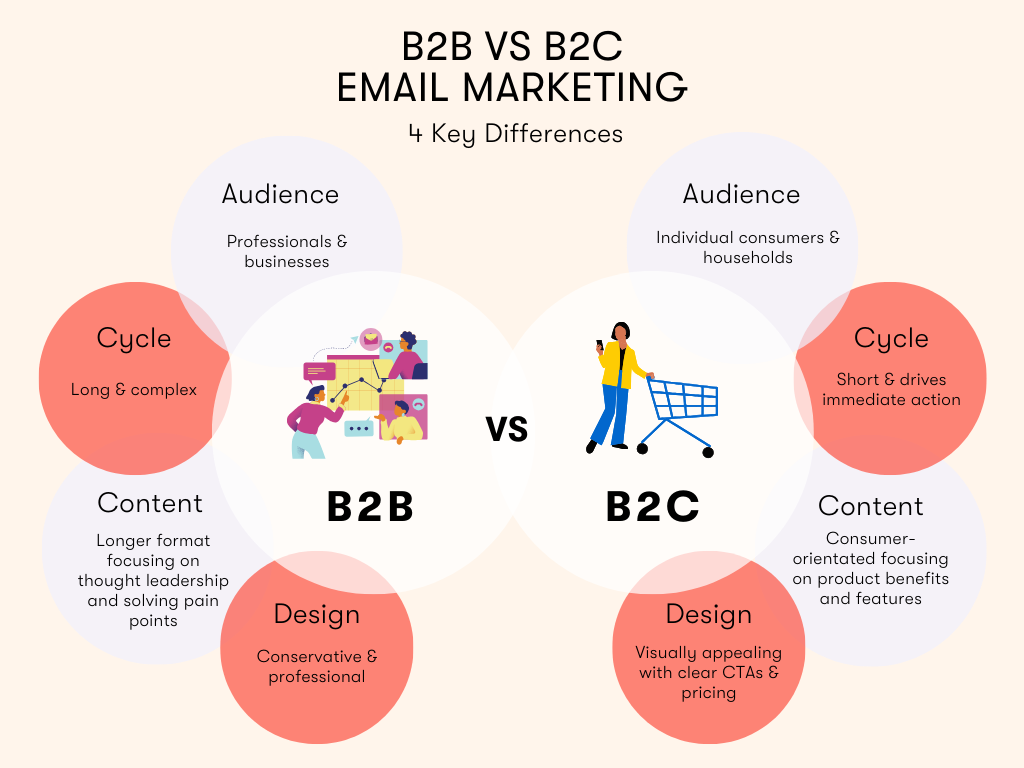
Email marketing is a powerful tool for both B2B (Business to Business) and B2C (Business to Consumer) companies. Though the basic principles are the same, there are key differences in strategy, execution, and audience engagement. Understanding these differences can help you tailor your approach for maximum effectiveness.
Audience Engagement
B2B and B2C email marketing engage with their audiences differently. In B2B marketing, emails are often targeted at professionals. They seek detailed, informative content that helps them make informed business decisions.
- B2B emails focus on industry insights, case studies, and white papers.
- The tone is usually formal and professional.
- Content aims to build long-term relationships.
In contrast, B2C emails target individual consumers. They aim to evoke emotions and drive quick actions.
- B2C emails focus on promotions, discounts, and new product launches.
- The tone is often casual and friendly.
- Content aims for immediate engagement and sales.
Sales Cycle
The sales cycle length differs greatly between B2B and B2C marketing.
| Aspect | B2B | B2C |
|---|---|---|
| Sales Cycle Length | Long-term, often months | Short-term, often days or weeks |
| Decision-Making Process | Complex, involves multiple stakeholders | Simple, individual decision |
| Content Focus | Detailed, informative, data-driven | Emotional, persuasive, visually appealing |
B2B sales cycles are longer due to the complexity of the decision-making process. It often involves multiple stakeholders and significant investments. Therefore, B2B emails need to nurture leads over time, providing valuable content that aids decision-making.
On the other hand, B2C sales cycles are shorter. Consumers make quicker decisions, often based on emotions and instant gratification. B2C emails should create a sense of urgency and encourage immediate action.
Email Design And Format
Email design and format are crucial for engaging your audience. The design should suit the type of audience you are targeting. Whether you are marketing to businesses (B2B) or consumers (B2C), the approach to email design will vary. Let’s explore how these designs differ.
B2b Email Design
B2B emails need to be professional and informative. The audience is looking for value and facts. Here are some key points to consider:
- Clean Layout: Use a clean, uncluttered layout. Keep the focus on the content.
- Professional Fonts: Select fonts that are easy to read and professional.
- Minimal Images: Limit the use of images. Focus on data and information.
- Longer Text: Provide detailed information. Your audience is looking for insights.
Here’s a quick example of a B2B email layout:
Quarterly Business Update
Dear [Name],
We are pleased to share our quarterly business update. In this edition, you will find insights on our latest projects, market trends, and strategic initiatives.
Key Highlights
- Project A: Completed ahead of schedule
- Market Trends: Analysis for Q3
- Strategic Initiatives: New product launch
Thank you for your continued partnership.
Best regards,
[Your Company Name]
B2c Email Design
B2C emails should be engaging and visually appealing. The audience is looking for excitement and deals. Key points include:
- Bold Layout: Use vibrant colors and a dynamic layout. Catch the reader’s eye.
- Engaging Fonts: Choose fun, readable fonts that match your brand.
- High-Quality Images: Include high-quality images and graphics. Make the email visually appealing.
- Short Text: Keep the text short and engaging. Focus on the offer.
Here’s an example of a B2C email layout:
Summer Sale!
Hi [Name],
Don't miss our Summer Sale! Get up to 50% off on selected items. Hurry, the offer ends soon!

Shop Now!
Shop Now
Happy Shopping!
[Your Company Name]
Metrics And Kpis
Email marketing plays a crucial role in both B2B and B2C markets. Measuring success requires understanding the right metrics and KPIs. These metrics help businesses evaluate their email campaigns. They provide insights to improve future strategies. Metrics and KPIs differ for B2B and B2C email marketing. Let’s explore the key differences.
B2b Metrics
B2B email marketing focuses on building relationships. Engagement is key. Important metrics include:
- Open Rate: Indicates the effectiveness of your subject lines. A high open rate means your subject line resonated with the audience.
- Click-Through Rate (CTR): Shows how well your email content engages recipients. High CTR implies that your content is compelling.
- Conversion Rate: Measures how many email recipients take the desired action. This could be signing up for a webinar or downloading a whitepaper.
- Lead Quality: Assesses the caliber of leads generated from email campaigns. High-quality leads often lead to more sales opportunities.
- Unsubscribe Rate: Helps you understand if your content is relevant. A high unsubscribe rate might indicate that your emails are not meeting expectations.
B2c Metrics
B2C email marketing aims to drive sales and build brand loyalty. Key metrics include:
- Open Rate: Reflects the appeal of your subject lines. A higher open rate suggests effective subject lines.
- Click-Through Rate (CTR): Indicates how engaging your email content is. High CTR means your audience is interested in your offers.
- Conversion Rate: Shows the percentage of recipients who made a purchase. High conversion rates are crucial for B2C campaigns.
- Revenue per Email: Measures the average revenue generated per email sent. This helps in understanding the financial impact of your email campaigns.
- List Growth Rate: Tracks how fast your email list is growing. A growing list indicates successful email marketing strategies.
Automation Tools
Email marketing automation tools simplify the process of managing campaigns. They help in scheduling, tracking, and personalizing emails. These tools are essential for both B2B and B2C businesses. They save time and increase efficiency. Automation tools vary for B2B and B2C due to different needs and goals. Let’s explore some popular tools in both sectors.
Popular B2b Tools
B2B businesses focus on building strong relationships. They need tools that offer advanced features. These features should support lead nurturing and pipeline management.
HubSpot is a popular choice. It offers email automation, CRM integration, and detailed analytics. Marketo Engage is another top tool. It provides robust lead scoring and account-based marketing features. Pardot, by Salesforce, is also widely used. It helps in lead management and provides deep insights into campaign performance.
Popular B2c Tools
B2C businesses aim to engage a broader audience. They need tools that offer personalization and segmentation. Ease of use is also important.
Mailchimp is a favorite among B2C marketers. It offers easy-to-use templates and powerful segmentation. Klaviyo is another strong contender. It focuses on personalization and customer data. Sendinblue is also popular. It offers SMS marketing and automation workflows.
Choosing the right tool depends on your business needs. Both B2B and B2C sectors have unique requirements. The right automation tool can enhance your email marketing efforts.
Case Studies
Case studies highlight the real-world effectiveness of email marketing strategies. They provide insights into successful campaigns and help marketers learn from proven tactics. Below are examples of successful B2B and B2C email marketing campaigns.
Successful B2b Campaigns
B2B email marketing focuses on building long-term relationships and providing valuable content. Let’s explore some successful campaigns.
| Company | Strategy | Outcome |
|---|---|---|
| HubSpot | Educational Content | Increased lead generation by 75% |
| Salesforce | Personalized Emails | Boosted engagement by 60% |
| Webinars and Whitepapers | Gained 50% more qualified leads |
HubSpot’s strategy involved sharing educational content tailored to the needs of their audience. This led to a significant increase in lead generation. Salesforce focused on personalized emails, which resulted in higher engagement rates. LinkedIn used webinars and whitepapers to attract more qualified leads.
Successful B2c Campaigns
B2C email marketing aims to drive immediate actions and build brand loyalty. Here are some successful examples.
| Brand | Strategy | Outcome |
|---|---|---|
| Spotify | Personalized Playlists | Increased user retention by 45% |
| Amazon | Product Recommendations | Boosted sales by 30% |
| Sephora | Loyalty Program Emails | Enhanced customer retention by 50% |
Spotify used personalized playlists to keep users engaged, resulting in higher retention rates. Amazon’s product recommendations helped increase sales. Sephora’s loyalty program emails significantly improved customer retention.
These case studies demonstrate how tailored email marketing strategies can drive impressive results, whether in a B2B or B2C context.
Future Trends
As we look ahead, both B2B and B2C email marketing are set to evolve. Future trends are expected to shape how businesses connect with their audiences. Understanding these trends can help marketers stay ahead of the curve.
Emerging Technologies
New technologies are changing email marketing. Artificial Intelligence (AI) can analyze data for better targeting. AI helps create personalized content. Machine learning improves email automation, making it smarter.
Virtual reality (VR) and augmented reality (AR) offer exciting possibilities. They can make emails more interactive. Subscribers can experience products virtually. This can boost engagement and interest.
Predicted Changes
Email privacy laws are becoming stricter. Businesses must adapt to these changes. Compliance will be crucial for maintaining trust. Marketers will need to focus on consent and data protection.
Customer expectations are evolving. People want more personalized and relevant content. Generic emails will be less effective. Personalized emails will become the norm.
Interactive content will gain popularity. Emails will include more videos, polls, and quizzes. This makes emails more engaging and fun. It also encourages more interaction from subscribers.

Credit: www.mailmunch.com

Credit: delesign.com
Frequently Asked Questions
What Is B2b Email Marketing?
B2B email marketing targets businesses, not individual consumers. The goal is to build professional relationships, generate leads, and drive sales.
What Is B2c Email Marketing?
B2C email marketing targets individual consumers. It focuses on personal engagement, promoting products or services, and driving consumer purchases.
How Do B2b And B2c Email Marketing Differ?
B2B email marketing focuses on professional relationships and lead generation. B2C email marketing emphasizes personal engagement and direct sales.
Which Is More Effective, B2b Or B2c Email Marketing?
Effectiveness depends on your target audience. B2B is effective for business relationships, while B2C excels in consumer engagement and sales.
Conclusion
Understanding B2B and B2C email marketing is crucial for your business strategy. Each approach requires different tactics and communication styles. B2B focuses on building relationships and providing value. B2C aims to capture attention and drive quick actions. Recognize your audience’s needs and tailor your emails accordingly.
This will enhance engagement and improve results. Always test and adjust your strategies for better performance. By doing so, you ensure effective email marketing.


